


Blog
Ozone 11 vs Ozone 12 Advanced: The Honest Upgrade Verdict

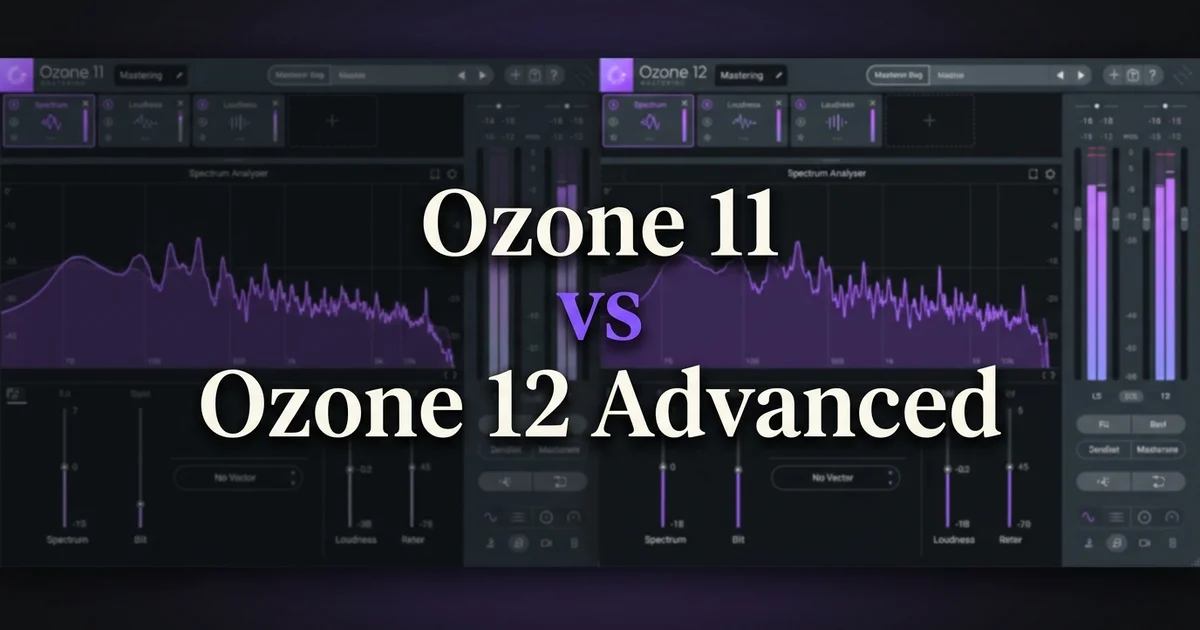
iZotope Ozone 11 vs Ozone 12 Advanced: version 12 adds the Stabilizer adaptive mastering EQ, a Custom Master Assistant flow, sharper Stem Focus and three entirely new plug-ins. I’ve mastered with both versions, and this guide covers what actually changed, what Ozone 11 still does well, the bundle question and which one fits your workflow — with a straight answer on whether the upgrade earns its price.
By Alex from VST Vault · Last updated 8 July 2026
Table of Contents
Ozone 11 vs Ozone 12 Advanced: the quick verdict
Buy Ozone 12 Advanced if you master multiple genres, want Stabilizer’s adaptive tonal balancing, or self-master for streaming and want the current flagship.
Buy Ozone 11 if Master Assistant already covers your workflow, the upgrade isn’t a budget priority, or you want a lower-cost entry into serious mastering.
My ten-second rule: if you master other people’s music or release weekly, take 12. If you master your own tracks a few times a year, 11 does the job. And if you release once or twice a year with real stakes attached, the honest third option is hiring a mastering engineer for those tracks and skipping the purchase entirely.
Ozone 11 vs Ozone 12 Advanced at a glance
Seven differences decide this upgrade. The whole picture in one table:
| Feature | Ozone 11 | Ozone 12 Advanced |
|---|---|---|
| Master Assistant | Genre-based suggestions | Custom flow — dozens of genre targets, module toggles, loudness goals |
| Stabilizer | Not included | Adaptive mastering EQ with 25 new genre targets |
| Stem Focus | Global processing | Improved neural networks — cleaner stem splits, fewer artifacts |
| New plug-ins | — | Stem EQ, Bass Control, Unlimiter |
| Maximizer | IRC 4 algorithms | Adds the new IRC 5 algorithm |
| Best for | Occasional self-mastering | Regular mastering, multiple genres |
| Price position | Lower-cost previous generation | Current flagship |
What’s new in Ozone 12 Advanced
Four changes matter, all confirmed on iZotope’s official Ozone page. Here they are in order of impact:
Stabilizer module
The headline. An intelligent adaptive mastering EQ that reshapes tonal balance in real time as the track changes, now with 25 new genre targets. Rather than a static EQ curve, Stabilizer keeps the chorus and the verse sitting in the same tonal frame. In my sessions it’s the module that most reduces manual EQ rides on a master.

Master Assistant with Custom flow
Upgraded. The new Custom flow lets you pick from dozens of genre targets, toggle modules and set loudness levels before the assistant builds the chain — so the starting point is yours, not a generic template. Faster suggestions, better first drafts.
Enhanced Stem Focus
Upgraded. Improved neural networks split stems with more precision and fewer artifacts — target the vocal for compression, the drums for saturation, the bass for EQ, independently, inside a finished stereo mix.
Three new plug-ins and IRC 5
New. Stem EQ equalises vocals, bass and drums separately inside a mixed file; Bass Control shapes the low end; Unlimiter restores dynamics to over-compressed material. The Maximizer also gains the new IRC 5 limiting algorithm.
How the upgrade behaves in a real session
Here’s the practical difference on an actual master, not a feature sheet. In Ozone 11 my session starts with Master Assistant, then twenty minutes of manual EQ moves chasing the low-mids between sections, then Maximizer tuning against the LUFS meter.
In Ozone 12 the same track goes: Custom Assistant flow with the genre target and loudness goal set up front, Stabilizer catching the verse-to-chorus tonal shift I used to ride by hand, and a final IRC 5 Maximizer pass. The result isn’t a different-sounding master — it’s the same destination with roughly half the manual moves. That’s the honest shape of this upgrade: time, not tone.
Where 12 genuinely does things 11 can’t: rescuing a mix you can’t reopen. Stem EQ pulls a buried vocal up inside a finished stereo file, Bass Control tames a woolly low end without touching the kick, and Unlimiter breathes dynamics back into an over-squashed bounce. If you master material you didn’t mix — client bounces, old sessions, licensing prep — those three tools alone justify the version jump.
What Ozone 11 still does well
Plenty. Master Assistant produces solid starting chains, Maximizer hits every streaming loudness target, and Equalizer, Dynamics, Imager and Match EQ cover the complete workflow — including reference-matching against commercial tracks, which is where most home masters go wrong. If your masters already sound right in Ozone 11, version 12 is a workflow improvement, not a rescue.
There’s also a stability argument for the older version: Ozone 11 has years of bug fixes behind it and behaves predictably in every major DAW. Buying the previous generation of a mature product is a perfectly sound strategy when the newest features aren’t the ones you’d use — it’s why we keep stocking it.

The pricing question
Ozone 12 Advanced costs more; VST Vault stocks both. In the Ozone 11 vs Ozone 12 Advanced decision, the maths is straightforward: Stabilizer, the Custom Assistant flow and the three new plug-ins are what the extra money buys. Master weekly and they pay for themselves in saved session time. Master occasionally and Ozone 11 covers most of the same ground — upgrade when the workflow gains matter to you, not before.
Should you buy Music Production Suite 9 instead?
Often, yes. Music Production Suite 9 includes Ozone 12 Advanced plus Neutron 5, Nectar 4 Advanced, RX 12 Standard, VocalSynth 2 and Insight 2 — 30+ plug-ins. If you plan to buy Ozone plus two other iZotope tools, MPS 9 costs less than collecting them separately. We recommend running that sum before buying Ozone alone.
The bundle isn’t automatic, though. If mastering is genuinely the only job you need covered — your mixes come from another engineer, your vocals are handled elsewhere — the standalone Ozone 12 Advanced purchase is the cleaner spend. Bundles only save money on plug-ins you’ll actually open.

Ozone 12 Advanced vs the FabFilter mastering chain
Two philosophies. Ozone 12 is AI-assisted: the assistant builds, Stabilizer balances, you refine. The FabFilter Total Bundle is hand-built precision: Pro-Q 4, Pro-MB and Pro-L 2 in a chain you construct yourself. Occasional self-masterers pick Ozone; full-time engineers often own both — our best mastering plugins guide maps the whole field.
A hybrid chain we see a lot in practice: Ozone 12’s Stabilizer and Equalizer for the tonal work, then FabFilter Pro-L 2 as the final limiter because its metering and true-peak control are the strongest in the business. Nothing says you have to stay inside one ecosystem — the modules don’t mind sharing a master bus.
And keep the jobs straight across the iZotope range: Ozone 12 Advanced masters full mixes, Neutron 5 mixes individual tracks, Nectar 4 handles vocal chains, and RX 12 Advanced repairs audio. Our mixing plugins guide covers the pre-master stages.
Frequently asked questions
Is Ozone 12 Advanced worth upgrading from Ozone 11?
The honest answer: yes if you master regularly — Stabilizer, the Custom Master Assistant flow and the Stem EQ, Bass Control and Unlimiter plug-ins are meaningful additions. If you master a handful of tracks a year, stay on Ozone 11 until the workflow gains would actually save you time.
Can Ozone 12 Advanced replace a mastering engineer?
For streaming releases with a clean mix, yes — Master Assistant plus Stabilizer plus Maximizer produce publish-ready masters. For a flagship release, a professional engineer’s trained ears still add value. Either way, Ozone 12 shortens the road.
What LUFS target should I master to?
Spotify normalises to -14 LUFS integrated, Apple Music to -16, YouTube around -14, and European broadcast runs -23 under EBU R128. The Maximizer in both versions meters LUFS integrated, so you can hit whichever target your platform requires — and keep the true peak under -1 dBTP so streaming encoders don’t clip your transients.
Does Ozone 11 get updates now that 12 is out?
iZotope’s active development is on Ozone 12; Ozone 11 keeps working but new features land in the current version. That’s the usual pattern across the industry — buy 11 for value today, not for future features.
Do both versions work on Apple Silicon?
Yes. Both Ozone 11 and Ozone 12 Advanced have native Apple Silicon builds and run on M1 through M5 Macs without Rosetta, as VST3, AU and AAX plug-ins in FL Studio, Ableton Live, Logic Pro, Cubase, Studio One, Pro Tools and Reaper.
Ready to buy?
However your Ozone 11 vs Ozone 12 Advanced decision lands, both ship from the mastering plugins collection at VST Vault with instant download after payment, Mac and Windows installers, and prices in pounds. Our team replies within six hours by email or WhatsApp — and if you’re still torn between the two versions, message us with your genre and release schedule and we’ll give you a straight recommendation.


