


Blog
Serum 2 vs Vital vs Pigments 7: Honest 2026 Verdict

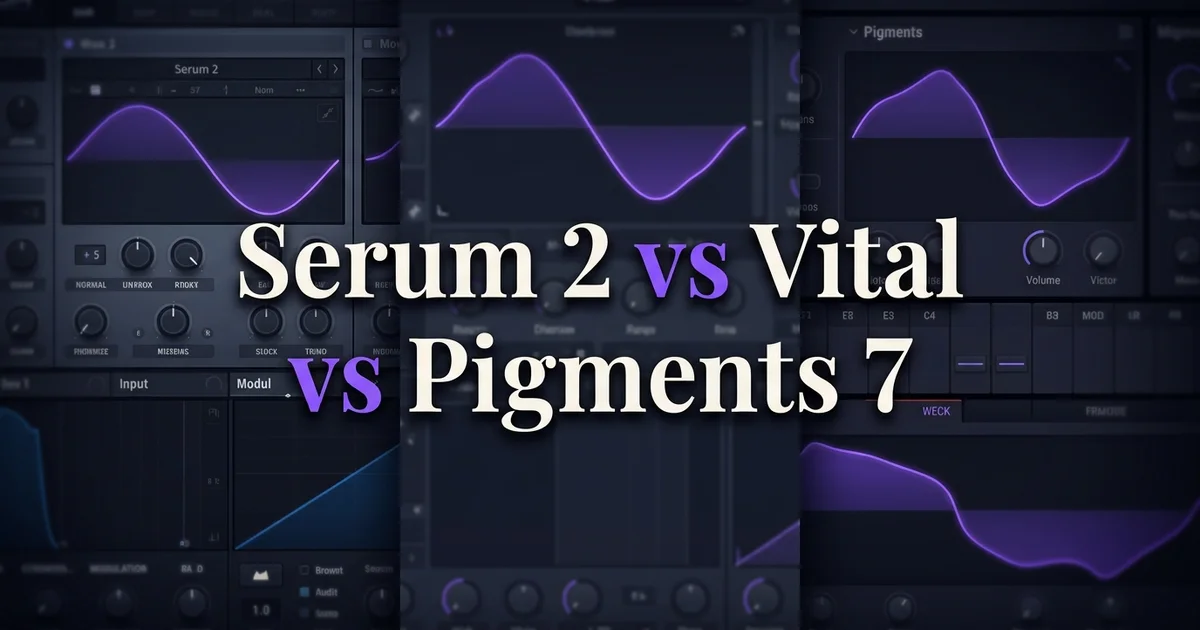
Serum 2 vs Vital vs Pigments: the three most-recommended wavetable synths of 2026. Serum 2 owns the preset ecosystem for electronic production, Vital delivers a genuinely serious free tier, and Pigments 7 is the hybrid Swiss Army knife with six synthesis engines in one interface. I’ve built patches in all three, and this guide picks the winner for your workflow — with an honest note on where each one loses.
By Alex from VST Vault · Last updated 8 July 2026. Serum 2 and Pigments 7 ship from VST Vault with Mac and Windows installers; Vital’s free tier comes direct from its developer.
Table of Contents
Serum 2 vs Vital vs Pigments: the quick verdict
Buy Xfer Serum 2 if you produce trap, dubstep, EDM or pop and want the synth every preset pack targets.
Buy Arturia Pigments 7 if you want one synth covering six synthesis methods — wavetable, virtual analogue, sample, granular, harmonic and physical-modelling Modal.
Try Vital if you’re not ready to spend — the free tier is a real synthesiser, not a demo. My rule: start free with Vital, and buy the day you catch yourself fighting its preset library instead of making music.
Serum 2 vs Vital vs Pigments at a glance
Seven rows decide this three-way. Here’s the whole picture:
| Feature | Serum 2 | Vital | Pigments 7 |
|---|---|---|---|
| Synthesis engines | 5 oscillator types: wavetable, multisample, sample, granular, spectral | Wavetable (spectral warping) | 6 engines: Modal, Granular, Wavetable, Sample, Harmonic, Virtual Analog |
| Preset ecosystem | The biggest in electronic music | Growing, much smaller | Strong factory bank, smaller third-party scene |
| Price model | One-time purchase | Free tier + paid tiers | One-time purchase |
| Upgrade policy | Free upgrade from Serum 1 | Free tier updates | Paid major versions |
| Best genres | Trap, dubstep, EDM, pop | Electronic, bedroom pop | Cinematic, ambient, experimental, hybrid |
| Learning curve | Fast for electronic producers | Fast, familiar layout | Deeper — more engines to learn |
| Where to get it | VST Vault | Developer’s site (free tier) | VST Vault |
Read the table by row three, not row one. All three sound professional; the price model and the preset economy are what actually change your day-to-day production. A synth with ten thousand third-party presets behaves like a different product from the same synth with three hundred.
Head-to-head: Serum 2 vs Vital
The short version: sonically close, ecosystem miles apart. The detail:
Sonic character
Both are modern wavetable synthesisers. Serum 2 has the cleaner high end and more aggressive modulation; Vital runs slightly warmer. In my blind A/B tests the differences are subtle enough that workflow and ecosystem should decide the purchase, not tone.
Preset ecosystem
Serum 2 wins decisively. Nearly every commercial preset pack in electronic music targets Serum — Cymatics, Splice creators and countless independents release Serum banks monthly, and Serum 2 loads every Serum 1 preset. Vital’s scene is growing but nowhere near that scale.

Price and what Serum 2 adds
Vital’s free tier covers real production work, with paid tiers adding presets and wavetables. Serum 2 is a one-time purchase — and per Xfer’s official page it brings five oscillator types (wavetable, multisample, sample, granular and spectral resynthesis), the Clip Sequencer and Convolve Reverb, with lifetime free updates and a free upgrade for Serum 1 owners. The sensible path many producers take: start on Vital free, buy Serum 2 when the ecosystem starts to matter.
Head-to-head: Serum 2 vs Pigments 7
This one is scope versus ecosystem — the broadest engine list against the deepest preset economy.
Synthesis scope
Pigments 7 wins — just. Per Arturia’s official page, Pigments runs six sound-generation methods across three engine slots: Modal physical modelling, Granular, Wavetable, Sample, Harmonic additive and Virtual Analog. Serum 2 closed much of the old gap with its five oscillator types, but Modal and Harmonic still produce territory — plucked physical tones, additive shimmer — that Serum doesn’t reach.

Interface and workflow
Serum 2 keeps the cleaner electronic-production workflow — everything a trap or pop session needs sits one click away. Pigments 7 offers more depth and takes longer to learn; the colour-coded modulation system helps, but six engines are six engines.
Preset ecosystem
Serum 2 wins. Same story as the Vital round — Serum owns the electronic music preset economy, and that gravity pulls tutorials, sound packs and collab sessions toward it.
Head-to-head: Vital vs Pigments 7
Both handle wavetable synthesis well. Pigments adds five further engines in the same purchase; Vital’s free entry makes it the zero-risk starting point. If you already know you want cinematic and experimental range, skip straight to Pigments — buying it after outgrowing Vital just delays the inevitable. If you’re still finding your genre, Vital costs nothing while you decide.
Worth a weekend test before you spend anything: install Vital free, then build the same patch — a supersaw lead, a wobble bass, an evolving pad — and note where you hit a wall. If the wall is presets, that’s a Serum 2 signal. If the wall is engine range, that’s Pigments. If you never hit a wall, keep the money.
Serum 2 vs Vital vs Pigments: which should you buy?
Match the synth to what you release, not to feature lists. Our team’s shortcuts:
Trap, dubstep, EDM or pop: Serum 2. The preset ecosystem is the deciding factor — every hook you learn from tutorials is built in Serum, and our best VST synth plugins guide ranks it first for exactly that reason.
Cinematic, ambient, experimental or hybrid pop: Pigments 7. Six engines cover more sonic territory than any single competitor here.
Just starting out: Vital free. When you commit, buy Serum 2 for electronic music or Pigments 7 for scoring — and in my experience that decision takes about three months of real production to make itself.
One more angle worth naming: how you like to work. Preset-first producers — load, tweak, record — get the most from Serum 2, because the world keeps feeding it new sounds. Sound-design-first producers who build patches from silence get the most from Pigments 7, because six engines give the blank page more directions. Neither approach is more professional than the other; hits ship from both camps every week.
Beyond these three — other synth options
The wavetable and hybrid market runs deeper than this trio — and in practice most working producers end up pairing one of the three above with a specialist from the list below rather than buying a second wavetable synth. A Serum-plus-Diva or Pigments-plus-Omnisphere pairing covers far more ground than two synths that share an engine type:

- Native Instruments Massive X — 170+ wavetables, phase-modulation oscillators, a darker character than Serum
- Spectrasonics Omnisphere 3 — the cinematic sound-design flagship with 40,000+ patches; see our Omnisphere 3 vs Massive X vs Reaktor 6 comparison
- u-he Diva — the truest analogue emulation for vintage warmth
- u-he Zebra 3 — the modular synth Hans Zimmer’s team runs
- reFX Nexus 5 — the preset-driven ROMpler for radio-ready hooks
Frequently asked questions
Is Vital really as good as Serum 2?
Sonically, close. Ecosystem-wise, no — Serum owns the electronic-music preset economy. If you release in trap, dubstep, EDM or pop, Serum earns its price through the packs and tutorials built around it. If you’re exploring synthesis without committing, Vital free is superb.
Is Serum 2 worth it if I already use Vital?
The honest answer: only if the ecosystem matters to you. Your synthesis skills transfer directly — both are wavetable synths with similar modulation thinking. What you gain is every commercial preset pack, the multisample, spectral and granular oscillators, and the Clip Sequencer.
Do I need Serum 1 if I buy Serum 2?
No. Serum 2 loads Serum 1 presets, so every existing pack works — and Serum 1 owners get Serum 2 free under Xfer’s lifetime-updates policy. If you already own Serum 1, the upgrade decision is no decision at all: install version 2 and keep everything.
Which synth do professional producers use?
Most professional electronic producers we deal with own Serum plus one hybrid (Pigments or Omnisphere) plus one analogue emulation (Diva or Repro). Serum is the default for trap and EDM; the others cover cinematic, ambient and vintage territory.
Do all three work on Apple Silicon?
Yes. Serum 2, Vital and Pigments 7 all have native Apple Silicon builds and run on M1 through M5 Macs without Rosetta, as VST3 and AU plug-ins in FL Studio, Ableton Live, Logic Pro, Cubase, Studio One and Reaper.
Ready to buy?
Wherever your Serum 2 vs Vital vs Pigments decision lands, the paid contenders ship from the synthesizer plugins collection at VST Vault — instant download after payment, Mac and Windows installers, prices in pounds. Our team replies within six hours by email or WhatsApp — tell us your genre and we’ll point you at the right synth and the preset packs to start with.


