


Blog
Omnisphere 3 vs Massive X vs Reaktor 6: Honest Verdict

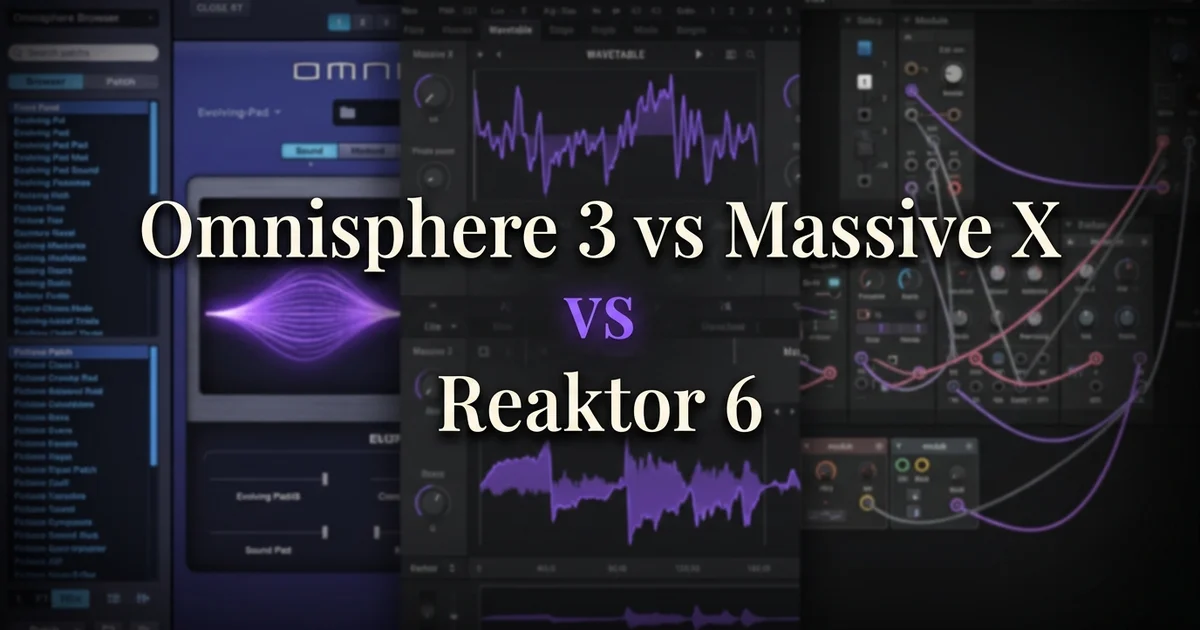
Omnisphere 3 vs Massive X vs Reaktor 6: three flagship synths for three different production styles — Omnisphere 3 for cinematic sound design, Massive X for aggressive modern wavetable, Reaktor 6 for modular custom-instrument building. I’ve spent serious session time in all three, and this guide picks the winner for your workflow rather than pretending one synth wins everything.
By Alex from VST Vault · Last updated 8 July 2026. All three ship from VST Vault with Mac and Windows installers.
Table of Contents
Omnisphere 3 vs Massive X vs Reaktor 6: the quick verdict
Short on time? Match the synth to your output:
- Spectrasonics Omnisphere 3 — cinematic, film and hybrid pop producers.
- Native Instruments Massive X — trap, dubstep, EDM and modern electronic producers.
- Native Instruments Reaktor 6 — sound designers and modular enthusiasts.
These three barely compete with each other — that’s the honest answer most comparison articles avoid. They’re flagship tools for three different jobs, and the real question is which job describes your next six months of production. Buy for the music on your calendar, not the music in your imagination: the synth that matches what you actually finish will earn its price in weeks, while the aspirational one gathers dust in the plug-in folder.
Omnisphere 3 vs Massive X vs Reaktor 6 at a glance
Seven rows tell the story:
| Feature | Omnisphere 3 | Massive X | Reaktor 6 |
|---|---|---|---|
| Type | Hybrid synthesis + sound library | Wavetable synthesiser | Modular platform |
| Sound content | 40,000+ patches, 70 GB library | 170+ wavetables, factory presets | 26 Blocks modules + 200+ partner modules + community ensembles |
| Signature tech | Quadzone synthesis, 300+ hardware profiles | Gorilla wavetable modes, Morpher, Animator | Primary and Core programming layers |
| Preset-friendly? | Extremely — browse and play | Yes — classic synth workflow | Only via ensembles |
| Learning curve | Moderate — vast library | Easy for synth users | Steep — it’s a build environment |
| Disk / CPU | ~70 GB disk, 8 GB+ RAM | Light on both | Light core, ensembles vary |
| Best for | Cinematic, hybrid pop, ambient | Trap, dubstep, EDM | Sound design, experimental |
Omnisphere 3 — the sound-design flagship
40,000+ patches, Quadzone hybrid synthesis and a 70 GB library — with Spectrasonics’ official specs listing 36 new filter types in seven sonic colours, 35 new effects units and over 300 hardware profiles for playing it from a real synth. Omnisphere is the instrument every professional film composer eventually buys: cinematic pads, evolving textures, drones and hybrid orchestral layers that pure wavetable synths can’t produce.
Best for: film composers, hybrid pop producers, cinematic scoring, ambient production, texture layering under orchestral cues. Buy Omnisphere 3 →

Massive X — modern wavetable aggression
170+ wavetables across 10 reading modes including the aggressive Gorilla family, phase-modulation oscillators, characterful filters with sub-modes, and Morpher and Animator for real-time patch transformation. This is the successor to the Massive that shaped 2010s dubstep and EDM — darker and more aggressive than Serum, which is exactly why producers keep both. I reach for it when a lead needs weight rather than shine; the phase-modulation section produces midrange growl that wavetable warping alone doesn’t get to.
Best for: trap, dubstep and EDM leads, cutting midrange basses, wobbles, and wavetable sound design with attitude. Buy Massive X →

Reaktor 6 — the modular sound-design platform
Not a preset synth — a platform where you build instruments. Blocks Base and Blocks Primes supply 26 patchable modules in the tradition of a modular synthesiser, 200+ partner modules extend the rack, and the Primary and Core layers let you programme DSP from scratch. The community ensemble library adds thousands of finished instruments on top.
Best for: sound designers, modular enthusiasts, experimental producers — anyone chasing sonic territory nobody else has. Buy Reaktor 6 →

Omnisphere 3 vs Massive X vs Reaktor 6: sonic territory
The cleanest way to hear the difference: Omnisphere makes the sound that carries the emotion, Massive X makes the sound that carries the hook, Reaktor makes the sound that doesn’t exist yet.
Omnisphere 3
Cinematic pads, evolving textures, ambient drones, hybrid orchestral layers, and User Audio sound design from your own samples. In my sessions it’s the first insert on any emotional cue — the browser’s Pads and Textures categories alone cover more scoring ground than most full synths.
Massive X
Aggressive dubstep basses, cutting trap leads, wobbles, modern electronic hooks and sound-designed FX. Where Serum reads bright and polished, Massive X reads dark and physical.
Reaktor 6
Anything you build — granular samplers, generative sequencers, feedback synthesisers, delays that shouldn’t work but do. The community library means you inherit two decades of other builders’ obsessions.
Learning curve and CPU
Massive X is the fastest to learn, Reaktor the slowest, Omnisphere the biggest to explore. The detail:
Massive X — familiar wavetable patterns; producers who know Serum or Vital adapt in an hour. Light on CPU and disk.
Omnisphere 3 — the interface is clean but the library is vast; I still find patches I’ve never heard after years with it. Budget around 70 GB of drive space and 8 GB+ RAM, per Spectrasonics’ minimum specs.
Reaktor 6 — Blocks patching takes hours to click, and building modules in Primary or Core takes weeks. Community ensembles are the shortcut; CPU load depends entirely on what you load.
A first-week plan for whichever you pick: spend day one only browsing factory content and starring what excites you. Days two and three, recreate two sounds from a track you love. By the weekend, commit one patch of your own making to an actual project. That last step matters most — a synth only becomes yours once it survives a real arrangement, and finishing a track with it is the fastest way to find out whether you bought the right one for the music you actually make.
Can you own all three?
Yes — professional sound designers routinely do, because the real answer to this three-way is “different days, different tools”. Omnisphere carries the cinematic work, Massive X the electronic sessions, Reaktor the experiments that become your signature sound. In my own template, all three sit loaded in different track groups.
Money-saving route: the Komplete 26 Collector’s Edition bundles Massive X and Reaktor 6 with 340+ other Native Instruments products — if you want two of the three synths here plus a full production suite, that’s usually the cheaper path than individual purchases.
Alternative synths in each category
Each flagship has credible rivals worth a look before you commit:
Cinematic alternatives to Omnisphere 3
- Omnisphere 2 — the previous generation, still deeply capable for less
- u-he Zebra 3 — the modular-but-friendly synth Hans Zimmer’s team runs
Wavetable alternatives to Massive X
- Xfer Serum 2 — the preset-ecosystem king; see our Serum 2 vs Vital vs Pigments comparison
- Arturia Pigments 7 — six synthesis engines in one interface
Modular alternatives to Reaktor 6
No direct software equivalent. Bitwig Studio’s The Grid is the closest modular workflow inside a DAW, and VCV Rack is the closest free alternative. In practice you buy Reaktor for its ensemble community, not because nothing else patches.
One pairing note before the FAQ: none of these three replaces a bread-and-butter preset synth. A typical serious setup runs Serum 2 or Nexus 5 for daily hooks, then adds one flagship from this guide for its speciality. Skipping the daily driver and going straight to Reaktor is the most common buying mistake we see — you end up with extraordinary tools and no finished tracks.
Frequently asked questions
Which flagship synth should I buy first?
I lean toward Massive X or Serum 2 first if you produce electronic music, and Omnisphere 3 first if you produce cinematic music. Reaktor 6 is a second or third purchase — after you own a preset-driven synth for daily production.
Is Omnisphere 3 worth the money?
Yes for film composers, hybrid pop producers and cinematic makers — the 40,000+ patches and Quadzone architecture reach territory no other synth covers. If you make bedroom electronic music with no cinematic ambitions, spend the money on Serum 2 and preset packs instead.
Is Massive X still worth it in 2026?
Yes — precisely because it doesn’t sound like Serum. The Gorilla wavetable modes and phase-modulation oscillators give it a darker, more physical character, and version 1.7’s additions keep it current. Producers usually run it alongside Serum, not instead of it.
Can I use Reaktor 6 without building anything?
Yes. Reaktor loads community ensembles from the Reaktor User Library and partner developers — thousands of ready-to-play instruments and effects, no module-building required. Building your own comes later, if ever. Plenty of Reaktor owners never patch a single Block and still get their money’s worth from the ensemble library alone.
Do all three work on Apple Silicon?
Yes. Omnisphere 3, Massive X and Reaktor 6 have native Apple Silicon builds and run on M1 through M5 Macs without Rosetta, as VST3 and AU plug-ins in FL Studio, Ableton Live, Logic Pro, Cubase, Studio One and Reaper.
Ready to buy?
However your Omnisphere 3 vs Massive X vs Reaktor 6 decision lands, all three ship from the synthesizer plugins collection at VST Vault — instant download after payment, Mac and Windows installers, prices in pounds. Our best VST synth plugins guide ranks the wider field, and our team replies within six hours by email or WhatsApp — tell us what you produce and we’ll recommend the right flagship, plus the preset packs and libraries that pair with it.


